
Austria
A Country That Has It All: History, Culture & Alpine Landscapes
TL;DR
Austria fascinated me long before I visited it. As a student, I was captivated by the history of the Austro-Hungarian Empire and the assassination of Archduke Franz Ferdinand. Years later, James Bond’s Spectre turned Sölden into a dream destination.
My first visit in 2017 was a brief solo stop in Vienna. The real Austria came alive during our 2019 Christmas family road trip through Salzburg, Hallstatt, Braunau am Inn, and Sölden. From Mozart’s birthplace and Christmas markets to alpine cottages, Bond locations, and unforgettable family moments, Austria exceeded every expectation.
Beautiful, historic, scenic, and surprisingly underrated, Austria remains one of Europe’s finest road-trip destinations.
The Lost Mumbaikar Says:
“Austria may be one of Europe’s most underrated destinations, quietly offering history, culture, alpine beauty, and unforgettable road trips.”
Austria: From History Books to Alpine Roads
As a school student, I was fascinated by history, and one chapter always stayed with me: the Austro-Hungarian Empire. Years later, in 2017, I found myself standing in front of the magnificent Schönbrunn Palace in Vienna, once the summer residence of the Habsburg dynasty and the heart of an empire that stretched across much of Europe. At the time, I admired its grandeur without fully appreciating how deeply its history had shaped the continent.
Two years later, in 2019, I stood near the Latin Bridge in Sarajevo, where Archduke Franz Ferdinand was assassinated. Suddenly, the connection became unmistakable. The heir to the empire whose palace I had admired in Vienna lost his life just a few steps from where I was standing. The story that once occupied a few pages in my history textbook had transformed into real streets, real buildings, and real places. What had seemed like distant history now felt remarkably tangible.
Austria had already been on my radar for another reason.
When the James Bond movie Spectre was released, the breathtaking scenes from Sölden immediately went onto my travel bucket list. The dramatic mountains, futuristic Ice Q restaurant, and alpine landscapes looked almost unreal.
My First Taste of Austria during my Solo Trip in 2017
Austria was the next stop after the Czech Republic during one of my solo European trips in 2017.
It was brief. Just two days.
Vienna was little more than a stopover before I continued towards Denmark and Norway. During my short stay, I explored some of Vienna’s must-do attractions, including Schönbrunn Palace, St. Stephen’s Cathedral, and the elegant streets of Vienna’s historic centre. Walking through the former imperial capital, it was easy to understand why Vienna is considered one of Europe’s great cultural cities.
Even in those two days, Vienna felt different from many European capitals. It was grand without being overwhelming, sophisticated without trying too hard.
On my second day, I made my way to Krems an der Donau, a charming town in Austria’s Wachau Valley. There I enjoyed traditional Austrian food, wandered through quiet streets, and experienced a slower side of the country away from the capital. Surrounded by rolling countryside, vineyards, and beautiful scenery, I realized Austria deserved far more than a quick stopover. This was a country that needed a proper road trip.
I left with a promise to myself that one day I would return with Julius and Jordan to explore Austria properly. I wanted them to walk through Schönbrunn Palace, discover the legacy of the Habsburg dynasty, and visit places connected to Archduke Franz Ferdinand, whose assassination changed the course of world history and had fascinated me since my school days.
But I knew I had only scratched the surface and the real Austria would come later.
Christmas in Austria – Where a Travel Dream Became a Family Memory
My first visit to Austria in 2017 was little more than a stopover in Vienna, but the Austria I truly remember came during our 2019 European Christmas road trip.
After leaving the Czech Republic, we began our Austria winter road trip, spending five unforgettable days across the country: two in Salzburg, two in Bad Goisern near Hallstatt, and one in Sölden before continuing towards Liechtenstein.
Looking back, I made one decision I still regret. I convinced Sunitha and the kids that we should skip Vienna. I told them that Salzburg, Hallstatt, and the Austrian Alps would offer a better Christmas experience. In reality, I was being selfish. I had already visited Vienna in 2017 and wanted to explore places that were new to me.
During our road trip to Salzburg, the kids kept reminding me that the Vienna Christmas markets are among the most beautiful and unique in Europe. They were right. Our Christmas road trip through Austria gave us unforgettable mountain landscapes, lakes, and small villages, but skipping Christmas in Vienna was one of the biggest mistakes in our itinerary.
Sometimes, a family trip should not be planned around the places you have already visited. It should also include the places your family has been dreaming of seeing.
Salzburg was the perfect introduction. For Sunitha, it was a city she already knew through The Sound of Music, a film she had watched countless times growing up after her father brought home a copy from Abu Dhabi. Long before she arrived, Salzburg had already become part of her imagination.
Our stay made the experience even more memorable. We checked into Hotel Vötterl, a historic property that proudly traces its origins to before World War II. Nestled in the foothills of the Northern Limestone Alps, our spacious apartment offered stunning mountain views and the kind of peace that felt straight out of a Sound of Music scene.
We explored many of the must-do attractions in Salzburg, including Mozart’s Birthplace, Mirabell Gardens, the historic Old Town, and the magnificent Hohensalzburg Fortress. Standing high above the city and looking towards the snow-covered Austrian Alps, it was easy to understand why Austria remains one of Europe’s most underrated destinations.
The Salzburg Christmas Markets, festive lights, local Austrian food, and mountain backdrop created an atmosphere that felt straight out of a storybook.
Salzburg is also inseparably linked with Wolfgang Amadeus Mozart, and we visited his former residence, now preserved as the fascinating Mozart Residence Museum. Walking through the rooms where one of history’s greatest composers once lived added another layer of appreciation for the city.
We spent our evenings wandering through the Christmas villages, enjoying the festive atmosphere, browsing local stalls, and soaking in the magic that makes Salzburg one of Europe’s finest winter destinations.
The Great Mulled Wine Mystery
Like many Christmas markets across Central Europe, Salzburg offered traditional mulled wine, perfect for keeping warm on a cold December evening. While enjoying a cup, I stepped aside to take a customer call, assuming my drink would be exactly where I left it. A few minutes later, I returned to discover that most of it had mysteriously disappeared.
The culprit was quickly identified.
While I was busy discussing business, Julius had quietly decided to conduct his own taste test. What followed was an entertaining evening and an even more entertaining drive, with a suddenly very talkative teenager providing nonstop commentary on everything he saw. Years later, we still laugh about it.
Hallstatt: Austria’s Picture-Perfect Postcard
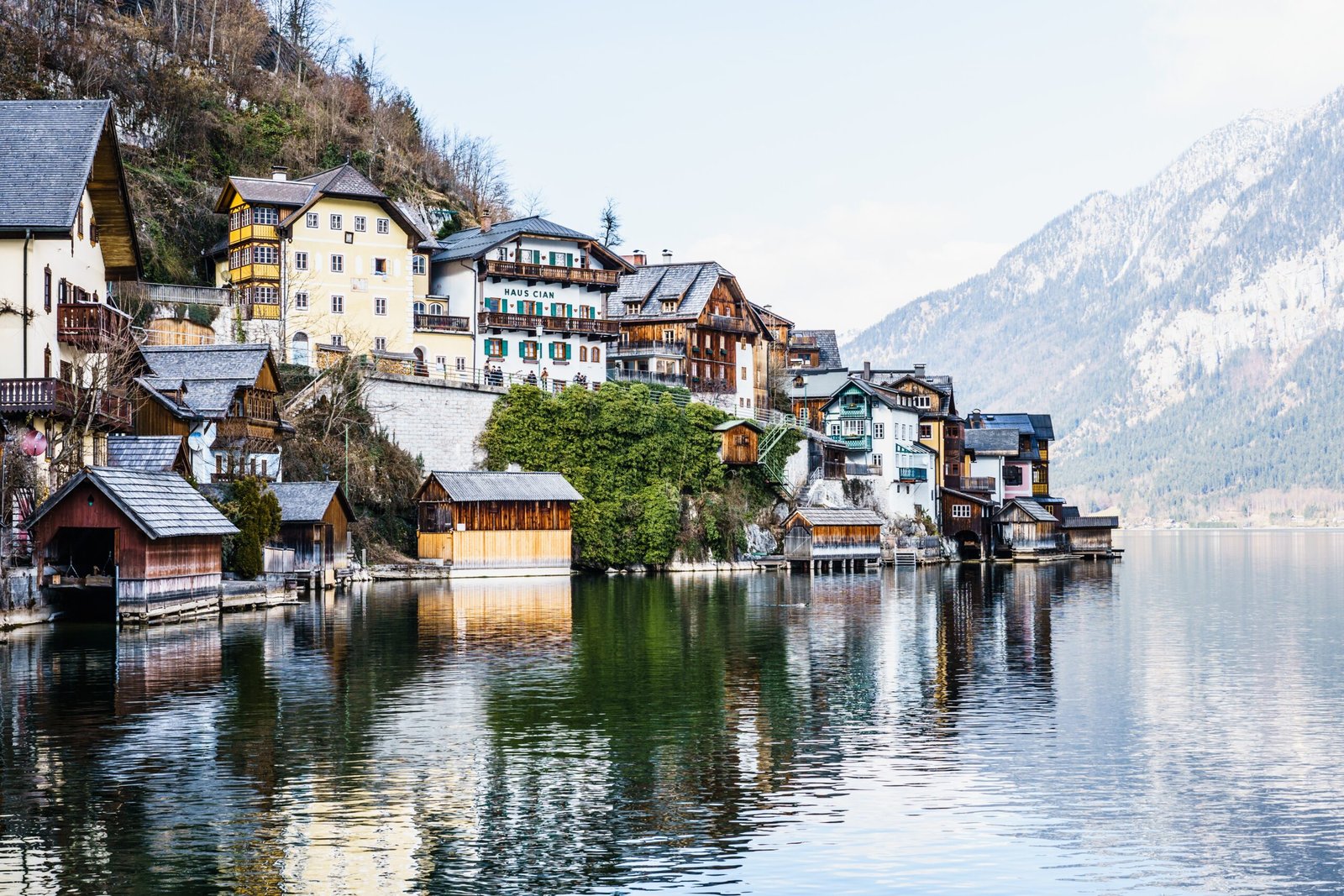
From Salzburg, we continued to Hallstatt, arguably the most photographed village in Austria. If there is one destination that represents Austria on postcards, travel brochures, and Instagram feeds around the world, it is Hallstatt.
While most visitors stay in Hallstatt, we decided to stay in Bad Ischl instead. It gave us the best of both worlds: a peaceful alpine setting away from the crowds, while Hallstatt was only a short drive away. It was one of the best accommodation decisions we made during our Austria winter road trip.
Mornings were spent enjoying fresh snowfall, capturing drone footage of the valley, and simply admiring the snow-covered peaks from our accommodation. Watching local trains pass through the landscape while clouds drifted across the mountains felt less like a holiday and more like living inside a travel documentary.
By afternoon, it was time to explore Hallstatt’s must-do attractions. We wandered through the charming lakeside village, visited the famous Hallstatt Skywalk, explored the historic Salt Mine, strolled along the waterfront, and stopped at several viewpoints overlooking one of the most photographed scenes in Europe. Every corner seemed designed for a postcard. The combination of alpine mountains, traditional houses, church spires, and the lake created a setting that almost looked too perfect to be real.
One of my favourite memories was sitting by the lake with the family, enjoying a wood-fired pizza while my camera quietly captured the changing scenery on timelapse. Snowflakes drifted across the mountains, boats moved slowly across the water, and Hallstatt looked exactly like the postcards that had inspired us to come here.
Even today, our family occasionally talks about that pizza and debates whether it was genuinely one of the best we have ever had or whether the setting simply made it unforgettable.
That is the beauty of travel. Food often tastes better when your surroundings are extraordinary, your mood is lighter, and you are fully present in the moment. The dopamine is higher, the conversations are richer, and even a simple meal becomes a lifelong memory.
Hallstatt certainly lived up to its reputation, but what I remember most is not the Skywalk, the Salt Mine, or the famous viewpoints. It was slowing down, watching the snowfall, sharing a meal with the people who matter most, and appreciating one of the most beautiful landscapes in Europe.
The Austrian Connection to Hitler
While driving from Salzburg towards Hallstatt, we made an unexpected stop in Braunau am Inn, a quiet Austrian town on the border with Germany. At first glance, it feels like many other small Central European towns, with colourful buildings, peaceful streets, and little indication that it holds a place in world history.
Braunau am Inn is known for one reason: it is the birthplace of Adolf Hitler, who was born there in 1889. Standing outside the building sparked an interesting conversation as Julius explained to Sunitha that, like many people, she associated Hitler entirely with Germany. He pointed out that Hitler was actually Austrian by birth before moving to Germany, where he rose to power, became dictator, and ultimately led Europe into the devastation of World War II. It was another reminder of how travel brings history far beyond the pages of a textbook.
The visit became less about Hitler himself and more about understanding how history shapes places. It was fascinating to think that a quiet border town in Austria was connected to events that changed the course of the twentieth century. Austria is rightly celebrated for Mozart, alpine scenery, imperial history, and culture, but places like Braunau am Inn remind us that history is rarely simple. Behind beautiful landscapes and charming towns are stories that influenced the modern world in profound ways.
Travel often turns textbook knowledge into something real. What begins as a chapter in a history book suddenly becomes a street, a building, or a place standing quietly beside your road trip route.
Sölden: Chasing a James Bond Dream
For me, Sölden was the highlight of Austria.
Ever since watching Spectre, I had wanted to visit the alpine village where some of the movie’s most memorable scenes were filmed. Like many James Bond fans, I was captivated by the dramatic mountain scenery, the futuristic restaurant perched above the clouds, and the feeling that this remote corner of Austria somehow looked more cinematic than the film itself.
The reality exceeded expectations.
Sölden is surprisingly small and quiet. Unlike some of Europe’s overcrowded destinations, it still feels authentic. The mountains dominate everything. As we boarded the gondola and climbed higher into the Ötztal Alps, the scenery became increasingly spectacular. Snow-covered peaks stretched in every direction, and it was easy to understand why this region has become one of Austria’s premier ski destinations.
At over 3,000 metres, we reached the famous ski area where thousands of skiers arrive every winter. The views alone were worth the journey. Long before Bond arrived, the Ötztal Valley was an important alpine crossing route connecting communities across the mountains. The region is also famous for Ötzi the Iceman, the remarkably preserved 5,300-year-old mummy discovered in the nearby Alps in 1991, one of Europe’s most significant archaeological discoveries.
For Bond fans, however, the real destination is the spectacular Ice Q Restaurant. Perched high above the valley, it served as the inspiration for the Hoffler Klinik featured in Spectre. The architecture feels futuristic, almost as if it belongs in a Bond movie even when cameras are not rolling. Sitting there surrounded by snow-covered peaks was one of the most memorable dining experiences of the entire trip.
Nearby, we explored the 007 Elements Museum, an immersive exhibition dedicated to James Bond and the making of Spectre. The museum showcases behind-the-scenes footage, props, production stories, and exhibits connected to the film. One of the highlights was seeing the vehicles used during filming, including Jaguars, Range Rovers, and replicas connected to the spectacular mountain chase sequences. There was even a model helicopter display that immediately brought back memories of the movie.
What impressed me most was how seamlessly the Bond experience blended with the natural beauty of the Alps. Many movie locations disappoint when you finally visit them. Sölden does the opposite. The mountains are grander, the scenery more dramatic, and the atmosphere more powerful than anything a camera can fully capture.
Seeing a place that had lived in my imagination since Spectre was released was one of those rare travel moments where reality actually surpassed expectation.
For a lifelong James Bond fan, it was worth every kilometre.
The Lost Mumbaikar Reflections
Travel has taught me that the memories we treasure most are rarely the ones we plan. We spend months researching routes, hotels, attractions, and famous landmarks. Yet years later, it is often a simple family moment that survives the longest.
For me, Austria will always include a missing cup of mulled wine, a family laugh, and conversations that lasted longer than the drive itself through Sound of Music places.
The best moments in travel are usually the ones that never appear on the itinerary. Austria remains one of Europe’s most underrated destinations. Many travellers spend a day or two in Vienna and move on. That is a mistake.
From the imperial legacy of the Austro-Hungarian Empire to Mozart’s Salzburg, from the postcard beauty of Hallstatt to the cinematic peaks of Sölden, Austria offers history, culture, mountains, lakes, road trips, and some of Europe’s finest Christmas markets.
It has much of the scenery people travel to Switzerland for, but often with fewer crowds and a more relaxed pace.
Austria first entered my life through history books. Then came James Bond movies. Then came solo travel and finally came family memories.
Looking back, I do not remember Austria only for its castles, museums, alpine roads, or mountain views.
I remember the snowfall outside our cottage, watching timelapses over Hallstatt, convincing my kids that the Christmas lights of Salzburg are better than Vienna.
And I remember a certain cup of mulled wine that mysteriously disappeared.
Some countries impress you while you are there. Austria stays with you long after you leave.
Your Turn:
If you had one week in Austria, what would make your itinerary: Vienna, Salzburg, Hallstatt, the Austrian Alps, or somewhere else? I’d love to hear your picks.
Frequently Asked Questions About Austria
1. Is Austria worth visiting?
Absolutely. Austria offers a perfect mix of historic cities, alpine landscapes, scenic drives, charming villages, and world-class music and culture. Whether you’re exploring Vienna, Salzburg, Hallstatt, or the Austrian Alps, it’s one of Europe’s most rewarding destinations.
2. What are the best places to visit in Austria?
Some of the top places to visit in Austria include:
- Vienna
- Salzburg
- Hallstatt
- Innsbruck
- Zell am See
- Sölden
- Grossglockner High Alpine Road
- Wachau Valley
- Graz
- Wolfgang
3. How many days do you need in Austria?
A 7–10 day itinerary is ideal for first-time visitors. This gives you enough time to experience Vienna, Salzburg, Hallstatt, and the Austrian Alps without rushing.
4. Is Hallstatt worth visiting?
Yes. Hallstatt is one of the most beautiful villages in the world, known for its lakeside setting, colourful houses, and mountain scenery. Visit early in the morning or stay overnight to enjoy it without the daytime crowds.
5. What is the best time to visit Austria?
The best time depends on your travel style:
- April–June:Pleasant weather and blooming landscapes.
- July–September:Perfect for hiking, alpine lakes, and road trips.
- October:Beautiful autumn colours.
- December:Christmas markets and festive atmosphere.
- January–March:Skiing and winter sports in the Alps.
6. Is Austria expensive to visit?
Austria is generally more affordable than Switzerland but more expensive than countries like Czechia or Hungary. Costs can be reduced by staying in guesthouses, using public transport, and eating at traditional Austrian restaurants.
7. What food should you try in Austria?
Don’t miss these Austrian favourites:
- Wiener Schnitzel
- Sachertorte
- Apple Strudel (Apfelstrudel)
- Kaiserschmarrn
- Tafelspitz
- Goulash
- Käsekrainer sausage
- Austrian alpine cheeses
8. Is Austria good for a road trip?
Yes. Austria is one of Europe’s best road-trip destinations. Scenic mountain roads, alpine passes, crystal-clear lakes, and picturesque villages make every drive memorable. The Grossglockner High Alpine Road is considered one of Europe’s greatest driving routes.
9. What are the best day trips from Vienna?
Popular day trips from Vienna include:
- Hallstatt
- Wachau Valley
- Melk Abbey
- Salzburg
- Bratislava (Slovakia)
- Graz
10. Why should you visit Austria?
Austria is a destination that combines history, culture, breathtaking alpine scenery, world-famous music, charming villages, and unforgettable road trips. Whether you’re exploring imperial Vienna, walking through Salzburg, or driving across the Alps, Austria offers experiences that appeal to every type of traveller.
Leave a Reply