
Vatican City
A Place More Than a Country, It Was a Blessing
TL;DR (For the Impatient Readers)
As a child growing up in Morak, Rajasthan, I often wondered how Vatican City could be smaller than the township where I lived. Years later, during my first Schengen visa trip to Europe in 2012 for a business meeting in Italy, I finally stood in the world’s smallest country. What began as a spontaneous four-hour visit became one of the most meaningful experiences of my travels. From walking through St. Peter’s Basilica and the Sistine Chapel to buying three simple crosses for my family, the Vatican reminded me that the places that leave the deepest impression aren’t always the biggest. They’re the ones that connect with your faith, your childhood and the dreams you quietly carried for years.
Vatican City: The World’s Smallest Country That Lived in My Imagination
Growing up in Morak, a small cement township in Rajasthan, there wasn’t even a church where we could attend Sunday Mass. Whenever there was Christmas, Easter or an important feast, our family travelled to Kota to attend church. Those journeys were never about convenience, they were about faith.
Every year, another tradition also arrived in our home without fail: The Malayala Manorama Yearbook. Long before Google, YouTube and Wikipedia, that yearbook became my passport to the world. I spent hours reading about countries, I had never heard of, studying their flags, capitals, populations and fascinating facts. Every page made the world feel a little smaller and my dreams a little bigger.
One country always stood out, Vatican City.
The yearbook described it as the world’s smallest independent country, covering less than half a square kilometre and home to only around a thousand people. I remember closing the book, looking around my colony and wondering,
“How can a country be smaller than the place where I live?”
That innocent childhood question stayed with me for years.
Back then, visiting Vatican City felt impossible. For a boy growing up in a small town without even a local church, seeing St. Peter’s Basilica, attending Mass in the spiritual heart of Catholicism or standing where Popes had stood for centuries seemed like something that happened to other people.
Looking back today, I genuinely believe my visit to the Vatican wasn’t simply another trip, It was God’s grace.
My First Schengen Visa
That opportunity arrived unexpectedly in Oct 2012, when I travelled to Italy for a business meeting with my customer, Page Europa.
In February 2012, I received my first Schengen visa, valid for one year. At the time, obtaining one wasn’t easy, so seeing that visa stamped in my passport felt like a personal achievement. More importantly, I made full use of it, returning to Europe second time was a great feeling.
Although this was my second trip using the same one-year Schengen visa, I still chose to enter Europe through Germany before continuing to Italy. Technically, there was no need to do that. Once you’ve entered the Schengen Area on a valid visa, you can enter through any Schengen country on subsequent trips. But nobody had explained that to me, and I didn’t think to ask. So, to avoid even the slightest chance of a problem, I took what I believed was the “safe” route.
Looking back, I smile at how overly cautious I was. I had created an immigration rule in my own mind that didn’t actually exist. Sometimes the biggest obstacles in travel aren’t the regulations, they’re the assumptions we make before checking the facts.
I spent a day exploring Germany before continuing to Italy.
Italy itself immediately captured my heart. Its history, architecture, food and culture eventually earned it a place among my Top 25 favourite countries, a story I’ve shared in a separate blog.
This article, however, isn’t about Italy.
It’s about the tiny country hidden within Rome’s city limits. A place, I had first discovered not on a map, but in the pages of a yearbook.
A Business Meeting That Became Something More
I had three days in Italy, and although there was plenty to see in Rome and beyond, there was one place I wanted to visit before anything else; Vatican City.
My meeting with Page Europa finished around 2 p.m. Most business travellers would probably have returned to their hotel or spent the rest of the afternoon exploring Rome. But I remembered the tiny country that had fascinated me since childhood. Since I was already there, I decided to head straight to Vatican City first, knowing I could explore the rest of Italy at a more relaxed pace over the following days.
What began as a simple decision to visit the Vatican before anything else became one of the most meaningful experiences of my journey through Italy.
Walking into Vatican City felt almost unreal. There were no immigration counters. No passport stamps, no customs officers.
One moment I was standing in Rome. The next, I had entered the world’s smallest sovereign nation.
Vatican City is the smallest independent country on Earth. Yet it serves as the spiritual and administrative heart of the Roman Catholic Church, home to the Pope and a destination visited by millions of pilgrims and travellers every year.
For many visitors, it is another famous landmark. For me, it was the answer to a childhood question that had travelled all the way from Morak to Rome.
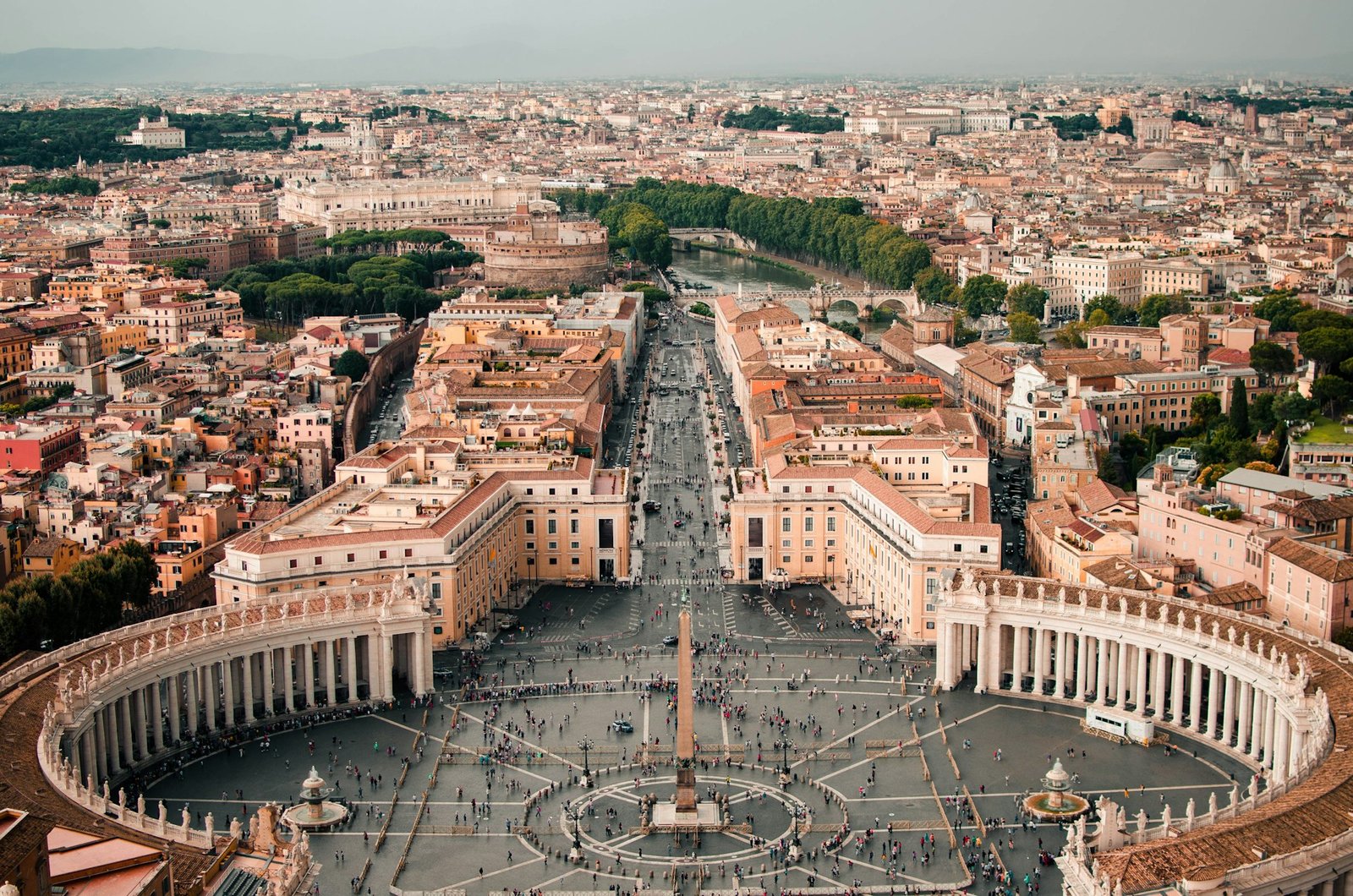
Standing at the Heart of Catholicism. The moment, I stepped into St. Peter’s Square, I understood why millions of people travel here every year.
Designed by the great Italian architect Gian Lorenzo Bernini, the vast square is surrounded by magnificent colonnades that seem to embrace pilgrims from every corner of the world. At its centre stands an ancient Egyptian obelisk that has witnessed centuries of history, papal ceremonies and countless gatherings of the faithful.
People around me spoke dozens of different languages. Some were tourists with cameras and others were pilgrims carrying rosaries.
Some stood quietly in prayer, while others simply sat in silence, taking in the atmosphere.
Despite welcoming thousands of visitors every day, the square carried an extraordinary sense of peace.
For me, this wasn’t just another famous landmark, it was the spiritual heart of the Catholic Church.
As a Christian who had grown up travelling to another city just to attend Mass, standing here felt deeply personal. It wasn’t about architecture or another country added to my travel map. It was about finally reaching a place, I had only imagined while growing up in Morak.
From the square, I walked into the breathtaking St. Peter’s Basilica, regarded as one of the holiest churches in Christianity and one of the greatest masterpieces of Renaissance architecture.
Nothing prepares you for its scale.
The soaring dome, designed by Michelangelo, seemed to disappear into the heavens. One masterpiece held me longer than any other: Michelangelo’s Pieta.
Carved when he was only twenty-four years old, the sculpture depicts the Virgin Mary holding the body of Jesus after the Crucifixion. I had seen photographs of it countless times. In fact, my father-in-law had a replica of the Pietà in his home, and later we brought it to our home in Mumbai. But standing before the original was a completely different experience. It wasn’t just a work of art.
It was emotion carved into marble.
I spent nearly four hours exploring Vatican City, including St. Peter’s Basilica, St. Peter’s Square, the Vatican Museums and the world-famous Sistine Chapel. Looking up at Michelangelo’s extraordinary ceiling, I realised why people travel from every corner of the globe to see it. Whether you are religious or not, it is impossible not to admire the patience, talent and vision that created one of humanity’s greatest artistic achievements.
Before leaving, I also stopped to watch the colourful Swiss Guard, instantly recognisable in their distinctive Renaissance-style uniforms. Many visitors assume they are ceremonial, but they remain one of the oldest active military units in the world, entrusted with protecting the Pope and Vatican City for more than five centuries.
Before walking back into Rome, I visited one of the small souvenir shops and bought three simple crosses. One for my parents, one for Sunitha, and one for her parents.
They weren’t expensive. But they remain among the most meaningful souvenirs I have ever brought home. Years later, those crosses still remind me that the most valuable gifts from travel are rarely the ones with the highest price tags.
Sometimes, they simply carry the deepest meaning.
Why the Vatican Inspires Millions
It is remarkable that a country covering just 44 hectares (109 acres) welcomes millions of visitors every year.
Some arrive as pilgrims and others come for history.
Many are drawn by art, architecture or simple curiosity.
Yet almost everyone leaves with the feeling that Vatican City is far more than just another tourist attraction.
Established as an independent state in 1929 through the Lateran Treaty, Vatican City is the sovereign home of the Holy See and the official residence of the Pope, the spiritual leader of more than 1.4 billion Catholics around the world. From this tiny nation, decisions, prayers and messages reach churches and communities across every continent.
For Catholics, visiting the Vatican is much like Muslims travelling to Mecca or Hindus visiting Varanasi. It is a place of deep spiritual significance, where centuries of faith come alive through prayer, tradition and history.
But you don’t have to be religious to appreciate its importance.
The Vatican Museums house one of the greatest collections of art ever assembled, with masterpieces by Michelangelo, Raphael, Leonardo da Vinci, Caravaggio and many other Renaissance masters. The Sistine Chapel, St. Peter’s Basilica and St. Peter’s Square are admired not only for their religious importance but also for their extraordinary contribution to world history, architecture and art.
That is what makes Vatican City so unique.
It is simultaneously a country, a place of worship, a museum, a historical archive and a symbol of faith for millions of people.
The Lost Mumbaikar Reflections
Ironically, I spent barely four hours in Vatican City. It remains one of the shortest country visits of my life. Yet it also became one of the most meaningful.
As I walked back into Rome that evening, I realised I hadn’t travelled there simply to visit another country, I had answered a question that had stayed with me since childhood.
A question that began while reading the Malayala Manorama Yearbook in a small township in Rajasthan. A question that followed me across continents.
Looking back today, I don’t remember Vatican City because it is the smallest country in the world.
I remember it because it reminded me that some places become important long before we ever visit them.
Sometimes through faith, sometimes through childhood curiosity and sometimes through dreams that quietly wait for the right moment to become reality.
For me, Vatican City will always be more than another destination on a map.
It will always be the place where a boy from Morak realised that no dream is ever too distant when life, faith and opportunity come together.
Your Turn
- What place in the world has taught you something about yourself?
For me, Vatican City wasn’t just about history or architecture. It reminded me how childhood curiosity can stay with us for decades.
I’m curious to know which destination has left that kind of mark on you.
Frequently Asked Questions (FAQs) About Visiting Vatican City
1. Is Vatican City worth visiting?
Absolutely. Despite being the world’s smallest country, Vatican City is one of Europe’s most remarkable destinations. Whether you’re interested in faith, history, Renaissance art, or architecture, it’s an unforgettable experience.
2. Can you visit Vatican City from Rome in one day?
Yes. Vatican City is located within Rome and can easily be visited as a half-day or full-day trip. Many travellers combine St. Peter’s Basilica, the Vatican Museums, and the Sistine Chapel in a single visit.
3. What are the top things to do in Vatican City?
The must-see attractions include St. Peter’s Basilica, St. Peter’s Square, the Sistine Chapel, the Vatican Museums, Michelangelo’s Pietà, and watching the Swiss Guard.
4. How much time do you need to visit Vatican City?
Allow at least 4–6 hours if you want to visit the Vatican Museums and St. Peter’s Basilica. If you’re short on time, you can still enjoy the highlights in 2–3 hours.
5. Do you need a passport to enter Vatican City?
No. There are no immigration or passport checks when walking from Rome into Vatican City, although carrying identification while travelling in Italy is always recommended.
6. What is the best time to visit Vatican City?
Early mornings are ideal for visiting St. Peter’s Basilica and the Vatican Museums, especially during spring and autumn when the weather is pleasant and crowds are smaller.
7. Is there a dress code for St. Peter’s Basilica and the Vatican Museums?
Yes. Visitors should dress modestly. Shoulders and knees should be covered when entering religious sites such as St. Peter’s Basilica.
8. What is Vatican City famous for?
Vatican City is famous for being the home of the Pope, the headquarters of the Roman Catholic Church, St. Peter’s Basilica, the Sistine Chapel, Michelangelo’s masterpieces, and one of the world’s greatest collections of Renaissance art.
9. Can non-Catholics visit Vatican City?
Yes. Vatican City welcomes visitors from all religions and backgrounds. Millions visit each year for its history, architecture, museums, and cultural significance.
10. Is Vatican City safe for tourists?
Yes. Vatican City is considered one of the safest places to visit in Europe. As with any major tourist destination, remain aware of your belongings, especially in crowded areas around St. Peter’s Square and nearby Rome.
Leave a Reply