

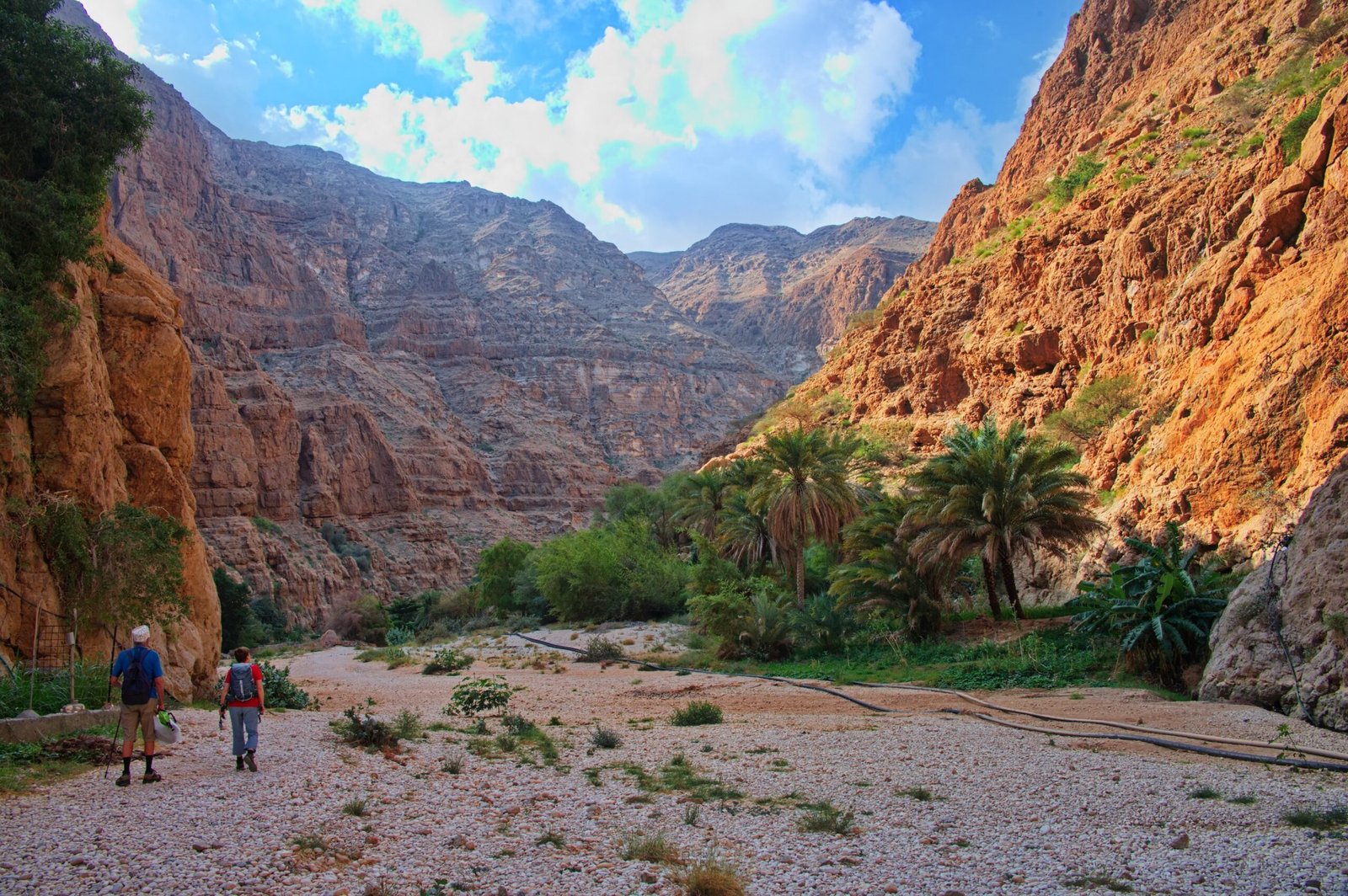
Best Wadis in Oman: Wadi Shab, Wadi Bani Khalid, Wadi Tiwi, Snake Canyon & Hidden Wadis
The Lost Mumbaikar Presents – The Ultimate Oman Road Trip Series
Chapter 5: The Oman of Emerald Wadis
There are places in Oman where Google Maps can take you to the parking area but still fail to take you to the place you actually came to see.
I learnt this particularly while exploring the wadis of Oman.
Search for the best wadis in Oman and you’ll quickly find Wadi Shab, Wadi Bani Khalid and Wadi Tiwi. Google Maps will give you a location. YouTube will show you beautiful turquoise pools. An Oman travel guide will tell you how many kilometres the wadi is from Muscat.
All of that is useful.
But a wadi isn’t a monument with one entrance and one viewpoint.
Sometimes the most beautiful pool is further inside. Sometimes you need to leave the car and walk. Sometimes the road that looks wrong turns out to be the right one. Sometimes you have to swim to reach what you’ve actually come to see. And sometimes Google announces that you’ve “arrived” when the real journey hasn’t even started.
This is where my Omani friend Mubarik changed the way I explored Oman.
I’ve mentioned Mubarik briefly in the “Destination” category where I blogged about Oman. He’s a local adventurer and traveller himself, which is probably one reason we connected so naturally. He doesn’t explore his country simply by driving to a famous viewpoint, taking a photograph and going home. He travels with the same curiosity with which I try to explore the world.
More importantly, he introduced my family to an Oman that had nothing to do with tourist attractions.
He took us to his village, where we spent time with his family, enjoyed Omani hospitality, music and culture, and ate the shuwa he prepared for us. Shuwa is one of Oman’s great traditional dishes: meat is marinated with spices, wrapped and traditionally slow-cooked underground for many hours, particularly during celebrations and family occasions.
This wasn’t a cultural performance organised for tourists, it was simply one family welcoming another family.
Those experiences changed my relationship with Oman. I stopped feeling as though I was continuously visiting the country next door and started understanding a little more about how Omanis themselves experience their villages, mountains and wadis.
And Mubarik taught me something else, “Google Maps can take you to a wadi. A local can show you the wadi”.
That difference became particularly obvious as he took me deeper into some of the most beautiful Oman wadis I had ever seen.
Wadi Shab: Oman’s Most Famous Wadi Still Deserves Its Reputation
If someone asks me to recommend just one of the best wadis near Muscat for a first-time visitor, Wadi Shab Oman would be difficult to ignore.
It is famous.
You’ve probably already seen the turquoise pools hundreds of times on Instagram.
Go anyway.
Wadi Shab is one of those rare famous attractions where the journey is actually more interesting than the photograph.
Nearest major city: Sur
Distance from Muscat: approximately 150 km
Driving time from Muscat: around 1 hour 45 minutes to 2 hours
Distance from Sur: approximately 45–50 km
Time to explore Wadi Shab properly: around 4–5 hours
4×4 required: No
The experience starts with a short boat crossing, and that detail surprises some first-time visitors because Google Maps makes Wadi Shab look as though you’ve arrived when you reach the parking area.
You haven’t.
The boat gets you across the water and then the Wadi Shab hike begins.
This is where people should stop thinking about Wadi Shab Oman as simply a beautiful swimming hole. You walk deeper between limestone cliffs and palm trees, following the valley until water gradually begins taking over the landscape. Eventually, you reach the natural pools and the Wadi Shab hike slowly turns into a swimming adventure.
My first experience here, however, was very different from the way I would explore Wadi Shab today.
I first came to Wadi Shab in 2013, long before Mubarik started showing me the Oman he knew. Jordan was only two years old, and for much of the trek I was carrying him on my shoulder or in my arms. Sunitha was with five-year-old Julius, who, as children somehow manage to do, kept wanting to move faster while I was constantly thinking about where he was putting his next foot.
And believe me, there were moments when I was scared.
The Wadi Shab trek is beautiful, but when you’re travelling with two very young children, carrying a two-year-old and moving across uneven rocks with steep drops and slippery sections, beauty isn’t the only thing going through your mind. There were places where I looked ahead and wondered whether we should continue.
The biggest uncertainty was that we simply didn’t know what was coming next.
Today you can search how to reach Wadi Shab, watch the entire Wadi Shab hike on YouTube, download maps, read reviews and know almost exactly where the pools begin and what the trail looks like. In 2013, we didn’t have that level of information in our hands. We were moving deeper into the wadi without really knowing how difficult the next section would be or what was waiting around the next bend.
Looking back now, with Jordan only two and Julius five, I probably wouldn’t recommend another family casually doing exactly what we did without properly understanding the trail and current conditions first.
But adventure was already somewhere in our DNA so we continued. And slowly the dry canyon began changing. The cliffs remained around us, but water became more dominant until eventually the hike became a swim.
For confident swimmers, Wadi Shab still had another surprise waiting.
The famous Wadi Shab cave and waterfall aren’t sitting beside the car park waiting for tourists. You have to earn them. You swim deeper through the natural pools before reaching the narrow opening that leads towards the hidden grotto and waterfall.
That uncertainty was part of what made my first Wadi Shab experience unforgettable. We weren’t following somebody’s Instagram reel or trying to recreate a photograph we’d already seen a hundred times.
That’s the real Wadi Shab experience.
Boat, hike, canyon, swimming, cave and waterfall.
This is why, I would allow four to five hours rather than treating Wadi Shab as another pin to tick off an Oman road trip itinerary.
Wear shoes suitable for rough walking and water, carry enough drinking water and protect your phone and valuables properly. Don’t arrive in flip-flops assuming this is a beach visit.
And don’t enter the deeper pools unless you’re comfortable swimming.
For anyone searching how to reach Wadi Shab from Muscat, the journey is straightforward along the coastal road towards Sur. But I wouldn’t necessarily drive from Muscat, finish Wadi Shab and immediately race back.
Bimmah Sinkhole, Wadi Tiwi and Sur are all in the same broad direction. Turn it into a road trip.
Wadi Tiwi: Where Knowing the Right Road Changes Everything
Only a short distance from Wadi Shab lies Wadi Tiwi Oman, yet the experience is completely different.
People planning their first trip often search Wadi Shab vs Wadi Tiwi as though they need to choose one.
If you have enough time, don’t.
Experience both.
Nearest major city: Sur
Distance from Muscat: approximately 160 km
Driving time from Muscat: around 2 hours
Distance from Sur: roughly 40 km
Driving time from Sur: around 35–45 minutes
Time to explore: around 2–4 hours; longer if exploring deeper
4×4: Not necessarily for reaching the general area, but useful for deeper exploration depending on route and road conditions
Wadi Shab is primarily about walking and swimming deeper into a dramatic gorge but Wadi Tiwi is about following water into an inhabited mountain landscape.
The road takes you past villages, date plantations, cliffs and pools. The deeper you explore, the more you realise these wadis aren’t simply recreational swimming locations.
Water created communities here.
Villages grew around it. Agriculture depended on it. Date palms survived because of it. Traditional irrigation systems distributed it.
That’s what makes Wadi Tiwi particularly interesting to me. You’re not simply looking at nature. You’re seeing the relationship between water and Omani village life.
And this is exactly the type of place where travelling with someone like Mubarik makes such a difference.
A map can tell you the road continues.
A local knows where to stop, which road to take, where to walk and from which point the wadi actually looks its best.
That’s information a pin on a screen doesn’t always give you.
If you’re planning a Muscat to Sur road trip, Wadi Shab and Wadi Tiwi belong naturally together. Add Bimmah Sinkhole and the coastline and you have one of my favourite adventure routes from Muscat. I will explain about these two in the other sections of the Oman series.
But give yourself time, Oman rewards people who aren’t in a hurry.
Wadi Bani Khalid: Don’t Stop at the First Beautiful Pool
Wadi Bani Khalid gives you almost the opposite experience. Where Wadi Shab makes you work before revealing its famous pools, Wadi Bani Khalid feels welcoming almost immediately.
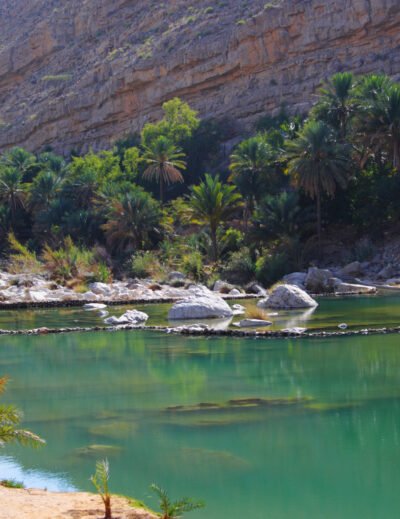
Water, date palms and mountains come together to create exactly the image people imagine when they search for the best swimming wadis in Oman.
Nearest useful bases: Ibra / Bidiyah
Distance from Muscat: approximately 230–250 km depending on route
Driving time from Muscat: roughly 2½–3 hours
Distance from Bidiyah: roughly 55–65 km
Driving time from Bidiyah: around 1 hour
Time to explore: approximately 2–4 hours
4×4 required: Generally no for the main visitor area
Its accessibility makes Wadi Bani Khalid particularly popular with families.
But this is where local knowledge again becomes useful.
Many visitors arrive, see the main pools, swim, take photographs and assume they’ve experienced Wadi Bani Khalid.
They’ve experienced part of it.
The wadi continues towards the Muqal area, where the landscape changes and there is more to explore beyond the obvious main pools. The wider area also includes the Muqal cave for visitors who understand the conditions and are appropriately prepared.
This is something I’ve repeatedly noticed while exploring Oman, “The first beautiful thing you see isn’t necessarily the most beautiful thing there”.
Sometimes you have to continue.
Wadi Bani Khalid also works brilliantly as part of a larger Oman road trip because of its proximity to A’Sharqiyah Sands, commonly known as Wahiba Sands which I will explain in the later part of the series.
Think about that contrast.
You can spend part of the day surrounded by clear water, date palms and mountains and later be driving between enormous desert dunes.
If you are staying around Bidiyah or Wahiba Sands, Wadi Bani Khalid becomes much easier to incorporate than treating it purely as a day trip from Muscat.
That’s exactly why knowing the nearest useful town or overnight base matters as much as knowing the distance from Muscat.
Wadi Al Arbeieen: A Wild Wadi Within Reach of Muscat
Once you’ve experienced Wadi Shab and Wadi Bani Khalid, Oman becomes even more interesting because you stop searching only for famous names.
Wadi Al Arbeieen is a good example.
Nearest major base: Muscat / Quriyat area
Distance from Muscat: approximately 120–140 km depending on route
Driving time: roughly 2–2½ hours depending on road conditions
Time to explore: allow around 3–4 hours
4×4: Recommended
Wadi Al Arbeieen offers the combination what I love about Oman: mountains, freshwater pools and a journey that feels slightly less organised than visiting a conventional attraction.
This is where having an appropriate vehicle becomes more important.
Access and road conditions can vary, and I would personally prefer a capable 4×4 when exploring rougher wadi routes rather than trying to prove that a small rental car can reach everywhere.
I’ve learnt that lesson enough times on road trips around the world.
The cheapest vehicle isn’t necessarily the cheapest vehicle once you’re stuck somewhere.
And this is another wadi where I’d check recent road and weather conditions rather than relying entirely on an old blog or video.
Snake Canyon & Wadi Bani Awf: When a Wadi Becomes an Adventure
Then there is Snake Canyon Oman, part of the wider Wadi Bani Awf landscape. This adventure was with my friend, Mubarik
I mentally separate Snake Canyon from the relaxing emerald pools of Wadi Bani Khalid because this is a completely different type of wadi experience.
This is adventure territory.
Nearest useful bases: Rustaq / Al Hamra depending on direction of approach
Distance from Muscat: roughly 150–180 km depending on access point and route
Driving time: highly dependent on mountain route and road conditions; don’t judge this trip purely by kilometres
Time required: half a day minimum; preferably a full day for a proper canyoning experience
4×4: Strongly recommended for the Wadi Bani Awf mountain routes
Guide: Recommended for technical Snake Canyon canyoning
The wider Wadi Bani Awf area takes you through spectacular Al Hajar Mountain scenery, villages and rugged roads. Snake Canyon itself becomes a narrow gorge where proper canyoning routes can involve scrambling, swimming, jumping, ropes and abseiling depending on the route and conditions.
This isn’t somewhere I would encourage an inexperienced traveller to enter simply because they watched someone do it on YouTube.
If you’re attempting Snake Canyon canyoning in Oman, use an experienced guide unless you genuinely have the necessary canyoning skills, equipment and local route knowledge.
There’s also something far more important than navigation.
Rain.
If there is one rule I would write in capital letters across every Oman wadi travel guide, it is this: NEVER UNDERESTIMATE A FLASH FLOOD.
The sky directly above you can look perfectly clear while rain is falling somewhere else in the mountains and a dry wadi is a drainage system.
When water arrives, the beautiful narrow canyon that attracted you there can become exactly the place you don’t want to be.
Always check the wider weather forecast before entering a wadi or canyon. If authorities, guides or locals advise against entering, don’t debate it.
There will always be another day.
Wadi Dima Wa’ttayeen: Another Side of Emerald Oman
One more destination deserves space in a serious guide to the best wadis in Oman: Wadi Dima Wa’ttayeen.
Nearest useful areas: Quriyat / Samail depending on the section being explored
Distance from Muscat: approximately 120–150 km depending on your destination within the wadi system
Driving time: around 2 hours or more depending on route
Time to explore: half a day is far better than rushing
4×4: Useful if exploring deeper sections
This is a broader valley system where the attraction isn’t concentrated around one famous swimming pool or one Instagram photograph. Mountains, palm groves, settlements, springs and pools are spread through the landscape. That makes it particularly interesting for the kind of traveller who enjoys exploring slowly.
Places like this also explain why I call this chapter The Oman of Emerald Wadis.
Oman isn’t green in the conventional sense. Drive across much of the country and you’ll see enormous areas of brown mountain, gravel plain and desert. Then you enter a wadi. Suddenly there are date palms, water, agriculture, villages and blue-green pools.
The colour feels even stronger precisely because everything surrounding it is so dry.
That’s one of the great visual surprises of an Oman road trip.
How I Would Plan an Oman Wadi Road Trip
I wouldn’t try to visit all of the best wadis in Oman in one frantic journey. Divide them geographically. For one of the easiest wadi road trips from Muscat, I would take the coastal route:
Muscat → Bimmah Sinkhole → Wadi Shab → Wadi Tiwi → Sur
That’s approximately the route I’d recommend to someone who wants maximum variety without a difficult mountain expedition.
Wadi Shab deserves around four to five hours if you’re doing the complete hike and swimming experience. Wadi Tiwi deserves another few hours. That’s why staying overnight around Sur makes much more sense than trying to rush everything and drive back to Muscat.
For another journey, combine:
Muscat → Wadi Bani Khalid → Bidiyah → Wahiba Sands
Now the experience changes completely.
You go from emerald water and date palms to some of Oman’s most famous desert dunes.
For mountain adventure, dedicate another day to:
Muscat → Wadi Bani Awf → Snake Canyon
And don’t underestimate the driving time simply because the distance doesn’t look enormous on Google Maps.
Wadi Al Arbeieen works well as a separate adventure from Muscat, while Wadi Damm makes more sense as part of a longer inland Oman itinerary around Ibri and western Oman.
The biggest mistake would be trying to turn the top wadis in Oman into a checklist.
That’s not how wadis work.
Some require hiking.
Some require swimming.
Some require a 4×4.
Some require a guide.
And some require nothing except enough time to sit beside the water and wonder how something so green appeared inside such a dry landscape.
Oman Wadis: Distance, Driving Time & How Long You Need
Wadi | Best Base | Approx. Distance from Muscat | Driving Time | Explore Time | 4×4? |
Wadi Shab | Sur | ~150 km | ~1¾–2 hrs | 4–5 hrs | No |
Wadi Tiwi | Sur | ~160 km | ~2 hrs | 2–4 hrs | Useful deeper inside |
Wadi Bani Khalid | Bidiyah/Ibra | ~230–250 km | ~2½–3 hrs | 2–4 hrs | Usually no |
Wadi Al Arbeieen | Muscat/Quriyat | ~120–140 km | ~2–2½ hrs | 3–4 hrs | Recommended |
Snake Canyon/Wadi Bani Awf | Rustaq/Al Hamra | ~150–180 km* | Varies | ½–1 day | Yes |
Wadi Damm | Ibri | ~300+ km | ~3½–4 hrs | 3–4 hrs+ | Preferable |
Wadi Dima Wa’ttayeen | Quriyat/Samail | ~120–150 km* | ~2 hrs+ | ½ day | Useful |
Distances for large wadi systems and mountain routes depend significantly on the exact access point and direction of approach. Treat these as planning estimates rather than navigation instructions and check current road conditions before travelling.
Best Time to Visit the Wadis of Oman and Precautions When Visiting a Wadi
For most Oman wadi adventures, I generally prefer October to April, when temperatures are more comfortable for hiking, swimming, driving and spending long hours outdoors. This is generally the best time to visit the wadis of Oman, especially if you are planning to explore places such as Wadi Shab, Wadi Tiwi, Wadi Bani Khalid or Snake Canyon.
But don’t confuse the best season to visit Oman wadis with whether a wadi is safe on that particular day. The most important factor isn’t what month appears in an Oman travel guide; it’s the weather that day and upstream.
Never enter a narrow wadi simply because someone says November or December is the perfect time to visit. Always check the current weather forecast and any local warnings. If significant rain has fallen or is expected in the mountains, change your itinerary. Flash floods in Oman wadis can happen quickly, even when the weather where you are standing appears fine.
Google Maps can tell you how to reach a wadi in Oman, the distance and the driving time but it cannot make the wadi safe.
The Lost Mumbaikar Reflections
I’ve travelled through Oman enough times to realise that some of my most beautiful memories there would never have happened if I had simply followed Google Maps.
Maps are brilliant. I still use them everywhere I travel. They can show you the road, the distance and exactly where to turn. But maps know coordinates. They don’t know people, memories or stories.
Mubarik did.
He didn’t simply take me to a wadi. He knew which road to follow, where to stop, which path would reveal the best view and when we needed to keep going because the real beauty was still somewhere ahead.
But the greatest thing he showed us wasn’t a hidden wadi but he took my family home. It started feeling like a place where I had friends waiting for me.
Frequently Asked Questions About the Best Wadis in Oman
1 Which is the best wadi in Oman?
For a first visit, I would choose Wadi Shab for the complete combination of boat, hiking, swimming and the cave waterfall. For easier access and beautiful pools, Wadi Bani Khalid is excellent. For villages and a more local road-trip experience, I love the character of Wadi Tiwi. For serious adventure, Snake Canyon is in a different category altogether.
2 Wadi Shab or Wadi Bani Khalid: which is better?
They’re completely different. Wadi Shab is an active adventure requiring hiking and swimming. Wadi Bani Khalid gives you much easier access to its famous pools. If your Oman itinerary allows it, experience both rather than choosing.
3 What are the best wadis near Muscat?
For travellers based in Muscat, Wadi Shab, Wadi Tiwi and Wadi Al Arbeieen are among the most useful options to consider. Wadi Shab and Wadi Tiwi work particularly well together on a Muscat-to-Sur road trip.
4 Can you visit Wadi Shab from Muscat in one day?
Yes. Wadi Shab from Muscat is one of Oman’s most popular day trips. However, I would personally combine it with the coastal route and stay around Sur if you have enough time.
5 How long do you need at Wadi Shab?
Allow roughly four to five hours if you want to enjoy the boat crossing, Wadi Shab hike, swimming and the cave/waterfall rather than rushing.
6 Can you swim in the wadis of Oman?
Many Oman wadis contain pools where swimming is part of the experience when conditions are suitable. Wadi Shab and Wadi Bani Khalid are two famous examples. Always consider your swimming ability, water conditions, weather and local restrictions.
7 Do you need a 4×4 for the wadis in Oman?
Not for every wadi. Wadi Shab and the main visitor area of Wadi Bani Khalid don’t require a serious off-road vehicle. For Wadi Bani Awf, Snake Canyon approaches and some remote wadi routes, a suitable 4×4 becomes much more important.
8 Is Snake Canyon safe without a guide?
For technical canyoning, I wouldn’t recommend an inexperienced traveller attempting Snake Canyon alone. Local route knowledge, canyoning skills, appropriate equipment and weather awareness all matter.
9 What should I wear when visiting an Oman wadi?
Wear comfortable clothing suitable for walking and swimming, footwear with grip, sun protection and clothing respectful of local customs, particularly around villages and family areas.
See Also:
- Grand Canyon of Oman: Jebel Shams and Jabal Akhdar
- Musandam, Oman: Exploring the Spectacular Fjords of Arabia by Road
Leave a Reply